

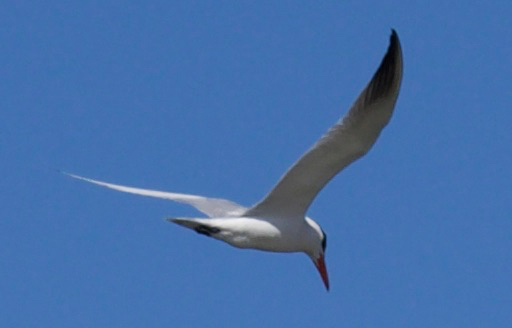
A Caspian Tern, Copley Retention Dam.
Excerpt from Birdlife Australia:
The largest of Australia’s terns, the Caspian Tern is also one of the most striking. With a ruby-red, dagger-like bill contrasting with a black cap and a neat combination of soft grey and white plumage, it’s one of the snappiest birds on our beaches.
Caspian Terns can be seen right around Australia’s coastline, where they usually inhabit sheltered bays, inlets and estuaries. There, they are often seen loafing singly or in small groups near the water’s edge on bare sand spits, banks of shells or patches of mud.
However, Caspian Terns also often occur well inland, particularly in the Murray–Darling and Lake Eyre Basins, as they often fly along inland waterways, and they’re occasionally recorded even farther inland, at artificial waterbodies in arid Central Australia and other dry regions. Indeed, one of their major breeding colonies is located on islands in Lake Moondarra, near Mount Isa.
Their steady and purposeful flight, with deep, powerful strokes on long, narrow wings give these birds a gull-like appearance, but this impression is quickly dispelled when they begin to forage. Like most terns, Caspian Terns plunge dive for their food. After cruising up to 15 metres above the water, they hover briefly before plunging, beak-first, into the water in the dramatic manner of a gannet. Their quarry is almost exclusively fish, which are usually eaten after the bird has taken flight once more. Sometimes they look out for other foraging birds which have already located shoals of fish at sea, then join in the fray, though some have also been seen stealing food from other, smaller seabirds.
Before the breeding season sets in, Caspian Terns perform a spectacular courtship display, with pairs diving from a great height, the birds twisting and turning in unison in a series of carefully choreographed aerial revolutions, before landing and gently preening one another.
Although Caspian Terns may breed in simple pairs, they often form colonies, which may comprise hundreds of pairs, often in association with other species of terns and gulls. Being such large birds, they are particularly conspicuous, especially when nesting among a colony of Fairy Terns!
Breeding may take place on the coast or at an inland wetland. The nest is a simple scrape in the sand, sometimes decorated with a few twigs, or some seaweed or shells, with each scrape situated just beyond the pecking distance of its neighbours. Two or three blotched and spotted eggs are laid, and they’re incubated by both sexes. After hatching, the chicks are led away from the nest by their parents, who diligently guard the young birds. If you approach to closely, they are likely fly rapidly towards you, calling all the while, and skimming just overhead — repeatedly!