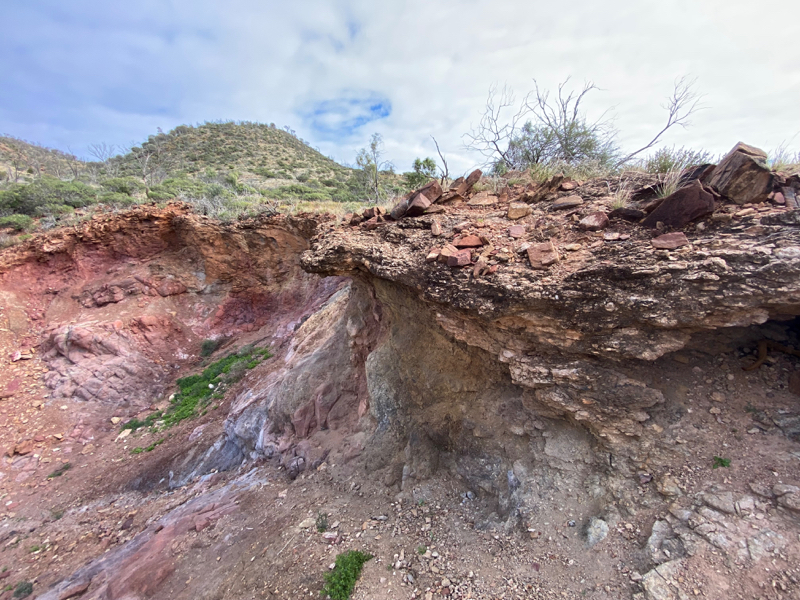
The Skillogalee Dolomite is a 750 million-year-old formation that is host to stromatolite fossils – the only evidence of complex living organisms at that time. Stromatolites are fossilised biochemical accretionary structures created by Cyanobacteria (‘blue-green algae’) colonies which form microbial mats and laminated mounds in shallow saline waters. Living stromatolites are found at the tip of the Yorke Peninsula (SA) and Shark Bay in (WA).
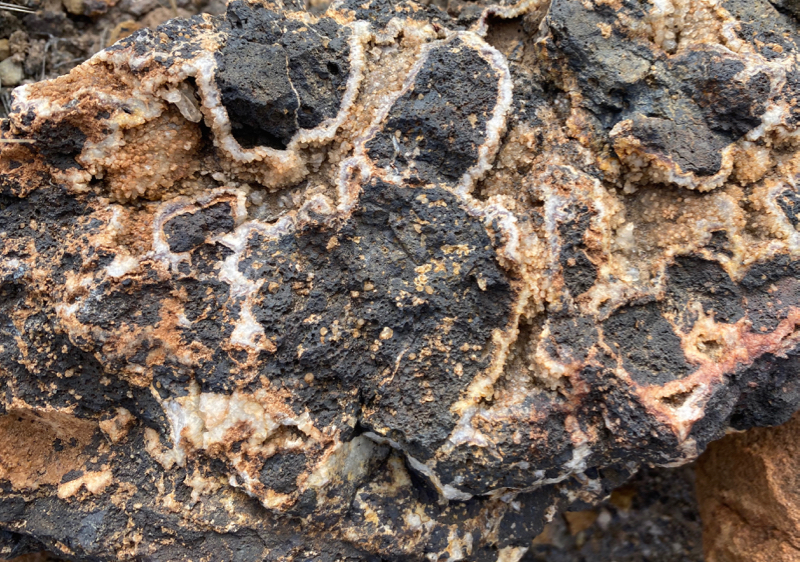
Skillogalee Dolomite includes blue-grey dolomites, magnesites, bands of black cherts and stromatolites. Magnesites (magnesium carbonate) of this formation were formed in marginal lagoons of the Adelaide Geosyncline around 750 million years ago and occur as beds, commonly conglomerate in texture, as pictured below.
A geological unconformity is an unconformable contact between two different lithologies. In the case of this formation in Jubilee Creek in the Northern Flinders Ranges, stromatolitic limestone of the Balcanoona Formation overlays laminated mudstone of the Tapley Hill Formation.
These two formations followed the melting of an ice age dating 700 million years ago. “Black silt, rich in fine organic material derived from algae and bacteria, was deposited as laminations (each less that 0.5mm thick) in the calm shelf sea. The total thickness of this silt blanket (known as the Tapley Hill Formation) increased from a few tens of metres in the west to about 3km in the ranges east of Hawker. Here depth of water and rate of subsidence of the basin floor were greatest. As silt built up, the water around the margins of the basin became shallow enough for stromatolites and oolite banks to form; these are exposed near Port Augusta and Balcanoona [Balcanoona Formation].” – Excerpt from The Legacy of Time: The Story of the Flinders Rangesby the Royal Geographical Society of South Australia.
Mt Neill Granite is exposed in a rocky creek near Paralana Hot Springs. The red feldspars of this 1580 million year old formation present in a variety of forms.
This lightweight Kaolinitic Granite at NE Arkaroola is an alteration of Mt Neil Granite. Hydrothermal fluids have destroyed the micas and replaced the feldspars of the original granite (1580 million years old) with Kaolinite.
Ripple marks, mud cracks and rain drop imprints indicate a shallow aquatic environment when the sediments of the Wortupa Quartzite formation were deposited around 790 million years ago.
Large amplitude ripple marks embedded into a 1x2m platformMudcracks (approximately 5mm thick) with sand infilling, in the Wortupa Quartzite formation
Kaolinite is a white soft mineral created by hydrothermal alteration or weathering of formations such as this example of Skillogalee Dolomite at Arkaroola.
The isopods (Phreatomerus latipes) living in the trickling overflow of the unique and beautiful Mound Springs north of the Flinders Ranges may look like garden slaters but are in fact a rare and ancient species of crustacean endemic to the ecological niche of the desert springs. Learn more about these evolutionary time capsules of the desert on the Friends of Mound Springs website.
Keep an eye on that orange dot for the backstory of the Flinders Ranges!
Professor Alan Collins from the University of Adelaide’s Earth Sciences Department in School of Physical Sciences is part of an international team who have reconstructed a one billion year history of the Earth’s tectonic plates.