
Green Emubush, Eremophila serrulata, flowering on the rocky slopes of the Acacia Ridge Trail, Arkaroola.

Green Emubush, Eremophila serrulata, flowering on the rocky slopes of the Acacia Ridge Trail, Arkaroola.
Arkaroola Education and Research Foundation with the Geological Survey of South Australia have published an excellent series of Geological Field Excursion Guides. Volume 1 is a self-guided driving tour from Arkaroola Village to Paralana Hot Springs, and Volume 2 is from Arkaroola Village to Sillers Lookout. The guides contain localised geological maps, satellite images and site photographs, with clear instructions on how to find specific formations en route. The accompanying geological notes are highly informative and a wonderful way to discover the stunning geological diversity of Arkaroola.
Hardcopies may be available for purchase in the Arkaroola Village shop or for viewing at the Leigh Creek Library on your way to Arkaroola.


It’s advisable to download a free PDF copy of the Geological Field Excursion Guides in advance. These have been provided by SARIG.
Continue reading “Geological Field Excursion Guides to Arkaroola”When not enjoying geology and astronomy tours at Arkaroola, one of the many ways to take in the spectacular mountain views is the Acacia Ridge WallkingTrail. It’s a 5.6km moderate walk across a mountain ridge, ending at the Arkaroola Village. The views of the ranges in all directions are breathtaking and there are many flowering plants inhabiting the rocky slopes that are uncommon in other parts of the Flinders Ranges.


Mt Neill Granite is exposed in a rocky creek near Paralana Hot Springs. The red feldspars of this 1580 million year old formation present in a variety of forms.


This lightweight Kaolinitic Granite at NE Arkaroola is an alteration of Mt Neil Granite. Hydrothermal fluids have destroyed the micas and replaced the feldspars of the original granite (1580 million years old) with Kaolinite.

For more information on how to locate this site, see Geological Field Excursion Guides.
The Wooltana Volcanics formation (830 million years ago) is visible on exiting Claude Pass on the Paralana Road at Arkaroola.
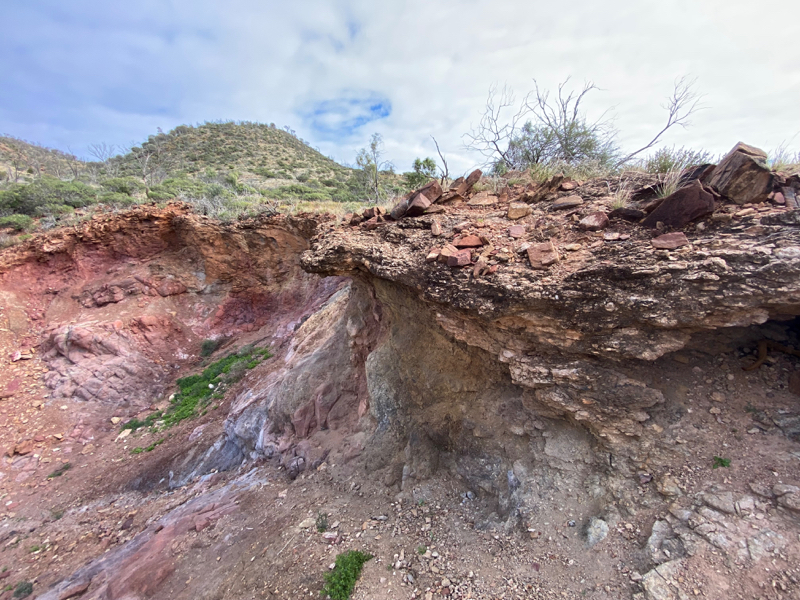
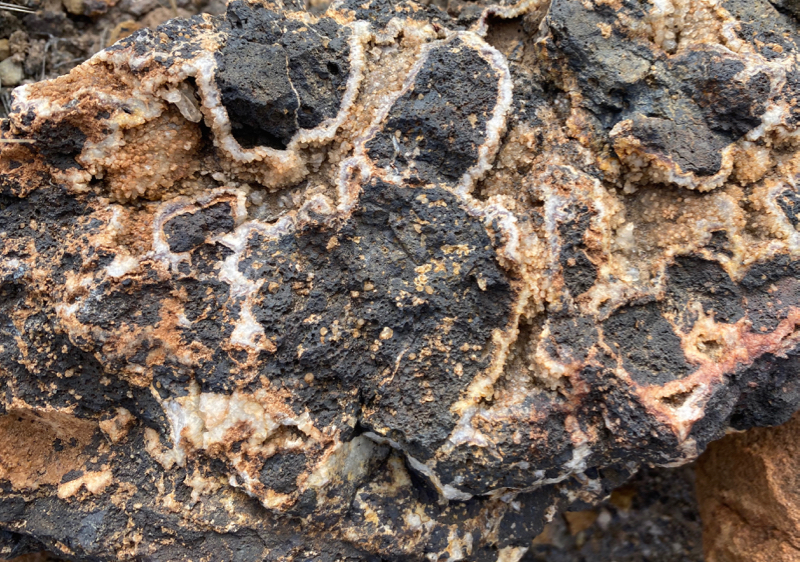
For more information on how to locate this site, see Geological Field Excursion Guides.
Ripple marks, mud cracks and rain drop imprints indicate a shallow aquatic environment when the sediments of the Wortupa Quartzite formation were deposited around 790 million years ago.


For more information on how to locate this site, see Geological Field Excursion Guides.
Kaolinite is a white soft mineral created by hydrothermal alteration or weathering of formations such as this example of Skillogalee Dolomite at Arkaroola.


Crimson Emubush (Eremophila latrobei) flowers range from pale red to purple. This deep pink variety is flowering in Welcome Pound at Arkaroola Wilderness Sanctuary during winter. Foliage varies from green to silvery grey.


While weathering and seasonal rains can cause waterholes at to silt up, Paralana Hot Springs continue to flow as a shallow stream. Sourced from within a fault zone, the water is around 60 degrees and emits gases such as radon which is heavier than air and hovers around the creek area on still days. A wonderful array of Cyanobacteria, Proteobacteria and algae thrive in the Paralana Hot Springs.


