


Sleepy Lizard
Tiliqua Rugosa, the Sleepy Lizard seen around the Flinders Ranges.

Sand: West of Copley
Lithic sand collected on a field trip to the hills west of Copley containing a small amount of clear quartz with fragments of assorted parent rocks – claystone, iron oxides, and coloured siltstones and sandstones.

Geological formation: West of Copley
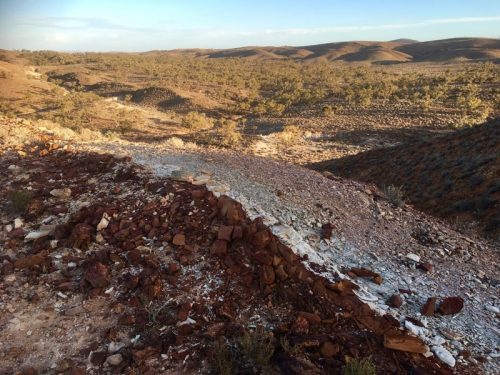
A trip to the hills west of Copley revealed a fascinating array of sedimentary rock formations. Within an approximate 100 metre square area, extensive layering was apparent. Dolomite layers were dominant to the south, typical of the local magnesite bearing formation. Within these layers were granular conglomerates with silicified seams.
Further along to the north were finely banded dolomites.

Evidence of glacial deposits was seen in tillite, pebbly layers and a course sandy / silty matrix.

Astronomy Camps in the Flinders Ranges
The Astronomical Society of South Australia (ASSA) will be hosting astronomy camps for members in May and August under the brilliant Flinders Ranges night sky. If you are a budding astronomer in the Flinders, check out the ASSA website for membership details.
Entering Solar Minimum
From space weather.com
Sunspots are becoming scarce. Very scarce. So far in 2018 the sun has been blank almost 60% of the time, with whole weeks going by without sunspots.
The fact that sunspots are vanishing comes as no surprise. Forecasters have been saying for years that this would happen as the current solar cycle (“solar cycle 24”) comes to an end. The surprise is how fast.
“Solar cycle 24 is declining more quickly than forecast,” stated NOAA’s Space Weather Prediction Center on April 26th. This plot shows observed sunspot numbers in blue vs. the official forecast in red:

Tiny bird skull
Found in Leigh Creek Township.
Hematite Pseudomorph after Pyrite

Iron oxide cubes found in a dolomite formation on the NW side of Leigh Creek commons.
Sands: Sliding Rock Area
Sliding Rock is the site of an old copper mine on the west side of Warraweena Conservation Park. The following 5 sand samples were taken in the area.
Old Copper Track

Lithic sand primarily composed from surrounding sedimentary rocks with some quartz crystals with hematite inclusions.

The Legacy of Time: Story of the Flinders Ranges
Excerpt: The legacy of time
First published by The Royal Geographical Society of South Australia Inc. in 1995.
The Flinders Ranges have been shaped by geological processes that, over hundreds of millions of years, have built the stage upon which the drama of biological interactions is being performed.
The Flinders Ranges form part of a highland chain extending from Kangaroo Island in the south through the Mount Lofty Ranges and Flinders Ranges to Marree and beyond in the north, to Olary in the east, and to Spencer Gulf and Lake Torrens in the west. Like many other mountain chains, they began their history as a subsiding sedimentary basin.
During the late Precambrian era, the Earth’s crust in South Australia consisted of granitic, metamorphic, sedimentary and volcanic rocks formed between 2600 and 1400 million years ago. In the present Flinders, the only rocks from that time are exposed near Arkaroola, including what are now known as the Freeling Heights Quartzite, Terrapinna Granite (Terrapinna Tors Walk) and Mt Neill Granite. Rocks that now constitute the eastern states of Australia were yet to form and the ancestral Pacific Ocean may have had its shores in South Australia. To the south, Australia was still joined to Antarctica.
The main area in South Australia then lay west of an approximate line from Adelaide to Oodnadatta; a smaller one existed in the vicinity of Lake Frome. The intervening area, where the Flinders and Mount Lofty Ranges now stand, became a long-lived basin known as the Adelaide Geosyncline, in which sediments accumulated 800 to 500 million years ago.
Continue reading – download PDF The Flinders Ranges – Legacy of Time