
Senecio magnificus flowering in spring, in Parachilna Gorge, pollinated by bee and Australian Lesser Wanderer butterly.


Senecio magnificus flowering in spring, in Parachilna Gorge, pollinated by bee and Australian Lesser Wanderer butterly.
Acacia pycnantha, the Golden Wattle, flowering in the Pichi Richi Pass south of Quorn in early Spring.


Domino bee (Thyreus lugubris) feeding on Eremophila duttonii at Wilpoorinna, north of the Flinders Ranges.

Green Emubush, Eremophila serrulata, flowering on the rocky slopes of the Acacia Ridge Trail, Arkaroola.

Wurmbea australis is endemic to South Australia. Seen here in the arid slopes of Nilpena in the Flinders Ranges in winter.


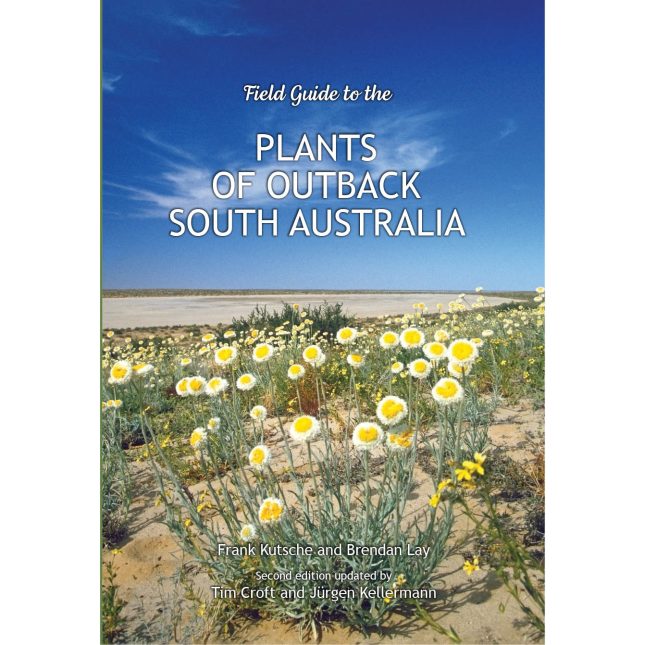
After nearly 15 years out of print, the second, fully revised edition of Plants of Outback South Australia has been published. A collaboration between the State Herbarium of South Australia (Botanic Gardens and State Herbarium) and the Pastoral Unit (Department for Environment and Water), this is a key field guide to South Australia’s arid lands.
Cassinia laevis, the native Curry Bush in flower, pollinated by a European bee at Ikara-Wilpena Pound in mid summer.

The Chequered Copper Butterfly (Lucia limbaria) is considered rare due to land clearance. Observed in the central Flinders feeding on a Capeweed flower, it uses the nearby Native Oxalis as a host plant.

The Chequered Copper butterfly has a unique relationship with ants, as outlined by Butterfly Conservation SA:
“This ‘copper’ butterfly belongs to the endemic Australian Theclinae group, which have a very strong obligatory association with ants. Both sexes are immune to attacks from their larval attendant ants by having pheromones the same as the ants, with the butterflies remaining with impunity in the presence of ant trails or near the entrance to ant nests. Larvae are attended by numerous small, common black ants Iridomyrmex sp (gracilis and rufoniger groups). The relationship is obligatory although the early stages can survive in captivity without the presence of ants. Interestingly, the pheromones of each ant colony that may be looking after a Small Copper colony must be different to distal ant colonies as translocation experiments of butterfly larvae between distal ant colonies results in the demise of the larvae.”
Annual forb Proliferous Pink (Petrorhagia nanteuilii) flowering in Warren Gorge in the Flinders Ranges.

Considered an aggressive weed in much of Australia, Pimpernel (Lysimachia arvensis) is short lived low growing herbaceous plant which can survive in many habitats including the arid lands of the Flinders Ranges.
