
The progression of iron oxide (goethite) concretions that have formed due to nucleation around small cracks in siltstone and shale. From the Copley area, northern Flinders Ranges.

The progression of iron oxide (goethite) concretions that have formed due to nucleation around small cracks in siltstone and shale. From the Copley area, northern Flinders Ranges.
Iron hydroxides percolating through sandstone can form concentric patterns called Liesegang rings. These palm sized samples were seen in a localised area to the west of Leigh Creek in the Flinders Ranges.


The dark bands seen between the rock layers are goethite, an iron oxide mineral that forms through the oxidation of iron-rich fluids along bedding planes or fractures in the rock.

Located within the Merinjina Tillite Formation, the smaller embedded rocks were likely deposited in this massive matrix by glacial activity. This tillite has since undergone oxidation, and in some areas, has been partially replaced by botryoidal goethite—a rounded form of iron oxide.

This group of goethite–quartz boulders may have formed from a hydrothermal seam or vent, where silica and sulfur-rich fluids precipitated quartz and pyrite. As pyrite oxidizes, it typically forms sulfuric acid, which accelerates iron oxidation, in this case forming goethite. As the surrounding blocky shale erodes, the more resistant goethite-quartz boulders remain – a common sight in the Flinders Ranges.

This very localised iron oxide outcrop is found within the Balcanoona Formation limestones of Black Oak Bore.


Botryoidal goethite.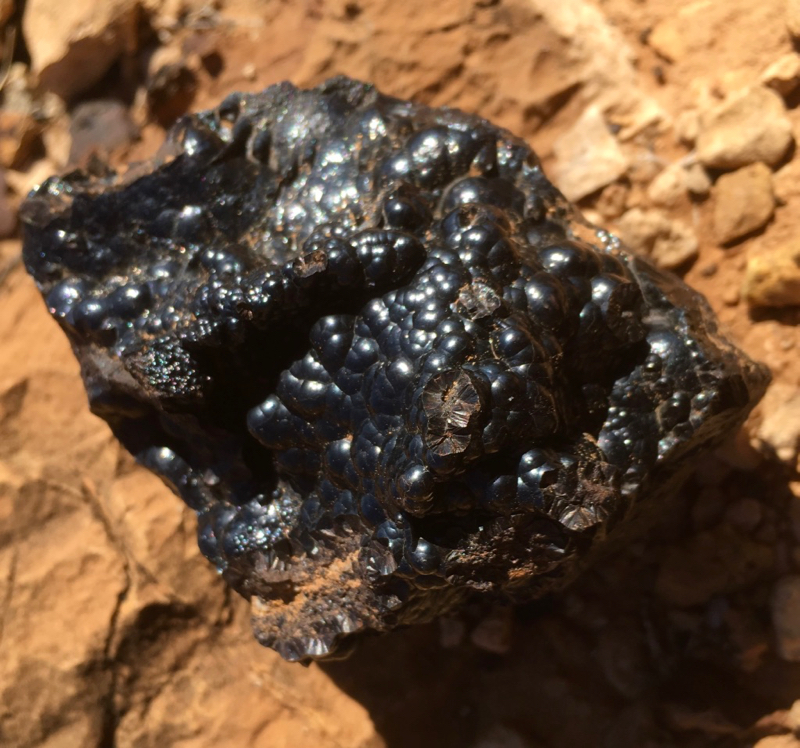


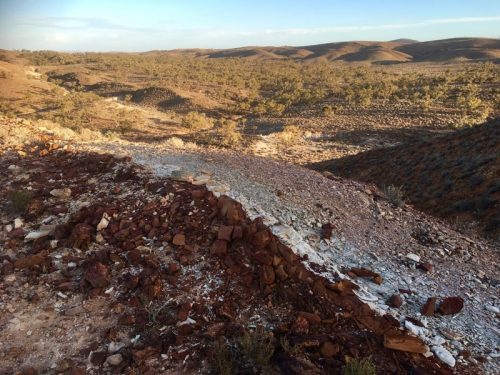
A trip to the hills west of Copley revealed a fascinating array of sedimentary rock formations. Within an approximate 100 metre square area, extensive layering was apparent. Dolomite layers were dominant to the south, typical of the local magnesite bearing formation. Within these layers were granular conglomerates with silicified seams.
Further along to the north were finely banded dolomites.

Evidence of glacial deposits was seen in tillite, pebbly layers and a course sandy / silty matrix.
