
Thin, layered shales of the Tapley Hill Formation, formed by deposition of fine sediment after the melting of the global Sturtian Glaciation which occurred 720 million years ago.
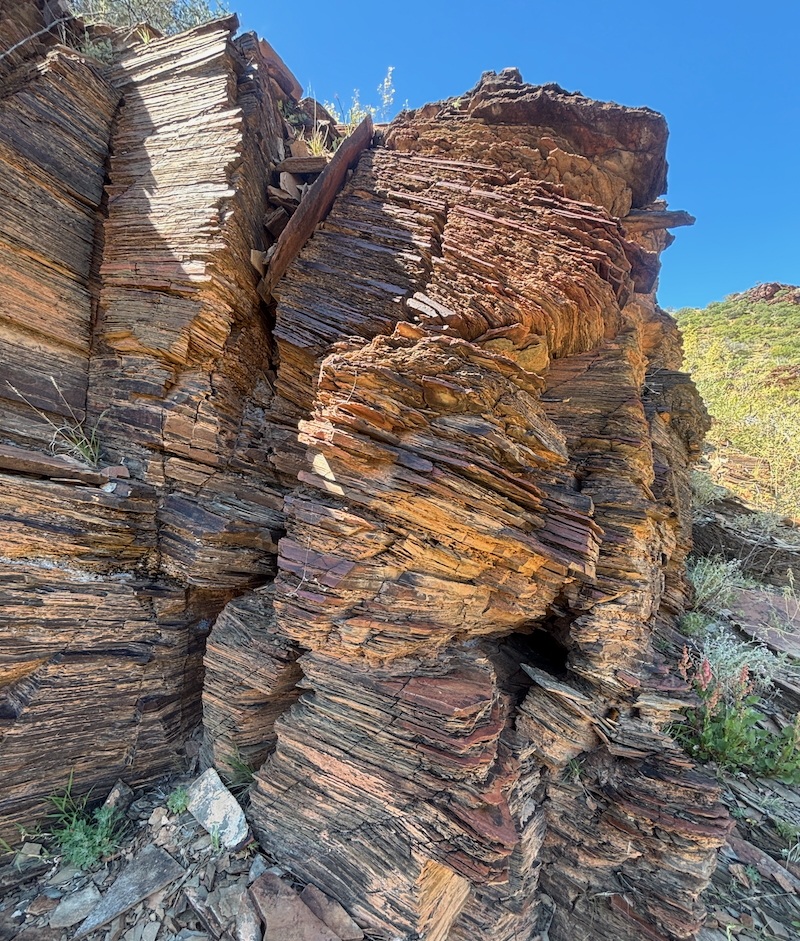
Thin, layered shales of the Tapley Hill Formation, formed by deposition of fine sediment after the melting of the global Sturtian Glaciation which occurred 720 million years ago.
This striking outcrop near Copley exhibits a range of sedimentary deposits. From the north to south, green shale and blocky siltstone meets weathered sandstone. This is followed by a distinct tillite layer between two dolomite layers, and a thin layer of quartzite. Further along, siltstone layers coloured by iron oxide, and more weathered sandstone.
Recent studies in the area suggest that the northern Flinders Ranges area was a shallow marine or lagoonal setting prior to the climate changing into one of the earth’s most severe glaciations ever recorded (the global Sturtian Glaciation), 720 million years ago . Over these older rocks, we find layers of pebbly, mixed rocks (called diamictites) that were likely deposited by a glacier at its edge, along with some sand layers (Bolla Bollana Tillite). These rock layers are thought to show the movement of the glacier as it advanced and retreated along the coastline. These layers then change into sandstones and mudstones with large rocks (called dropstones), which probably formed when the ice started to melt, in an area just in front of the retreating glacier (Wilyerpa Formation). After the glacier melted, the layers of rock that formed (Tapley Hill Formation) include thin, layered shales and carbonates that were deposited underwater.
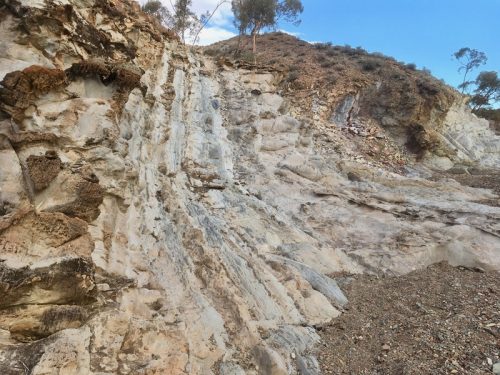
Weathered sandstone:
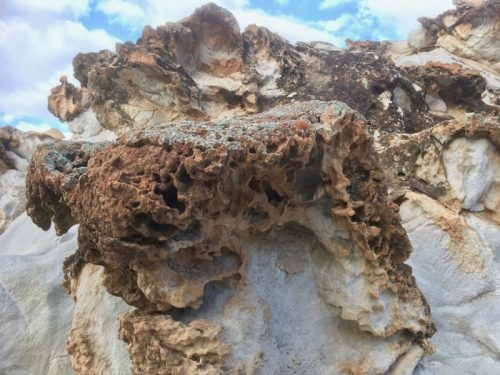
A geological unconformity is an unconformable contact between two different lithologies. In the case of this formation in Jubilee Creek in the Northern Flinders Ranges, stromatolitic limestone of the Balcanoona Formation overlays laminated mudstone of the Tapley Hill Formation.
These two formations followed the melting of an ice age dating 700 million years ago. “Black silt, rich in fine organic material derived from algae and bacteria, was deposited as laminations (each less that 0.5mm thick) in the calm shelf sea. The total thickness of this silt blanket (known as the Tapley Hill Formation) increased from a few tens of metres in the west to about 3km in the ranges east of Hawker. Here depth of water and rate of subsidence of the basin floor were greatest. As silt built up, the water around the margins of the basin became shallow enough for stromatolites and oolite banks to form; these are exposed near Port Augusta and Balcanoona [Balcanoona Formation].” – Excerpt from The Legacy of Time: The Story of the Flinders Ranges by the Royal Geographical Society of South Australia.

Shales of the Tapley Hill Formation.
