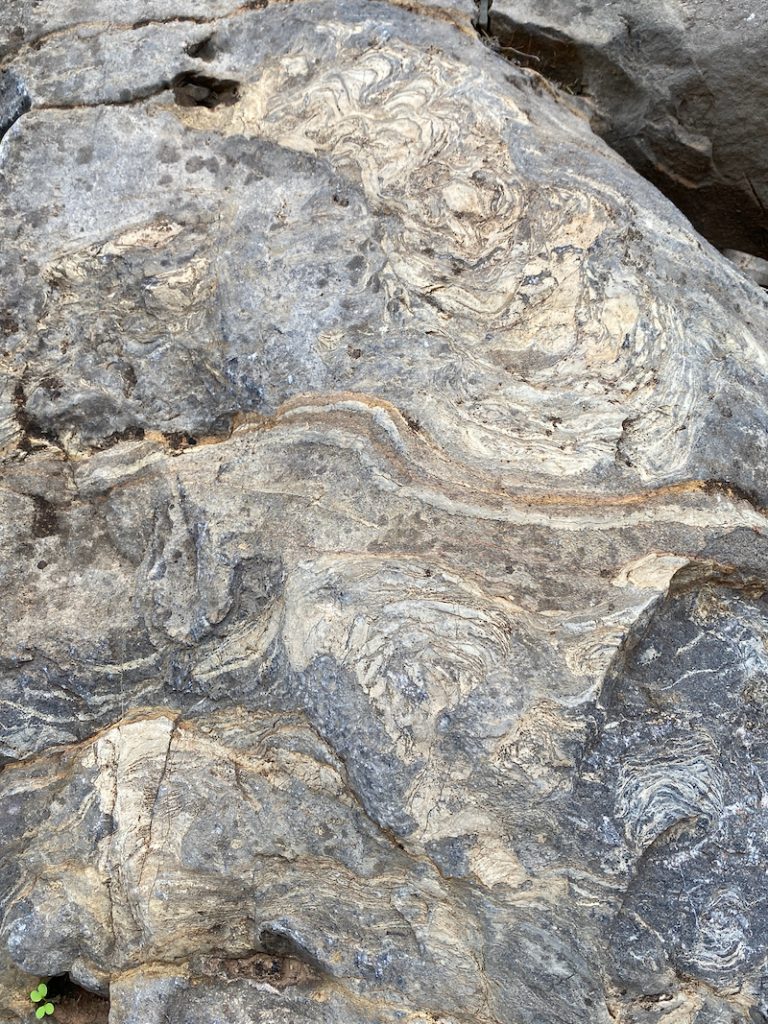
Glacial geological formation: sedimentary deposits

This striking outcrop near Copley exhibits a range of sedimentary deposits. From the north to south, green shale and blocky siltstone meets weathered sandstone. This is followed by a distinct tillite layer between two dolomite layers, and a thin layer of quartzite. Further along, siltstone layers coloured by iron oxide, and more weathered sandstone.

Recent studies in the area suggest that the northern Flinders Ranges area was a shallow marine or lagoonal setting prior to the climate changing into one of the earth’s most severe glaciations ever recorded (the global Sturtian Glaciation), 720 million years ago . Over these older rocks, we find layers of pebbly, mixed rocks (called diamictites) that were likely deposited by a glacier at its edge, along with some sand layers (Bolla Bollana Tillite). These rock  layers are thought to show the movement of the glacier as it advanced and retreated along the coastline. These layers then change into sandstones and mudstones with large rocks (called dropstones), which probably formed when the ice started to melt, in an area just in front of the retreating glacier (Wilyerpa Formation). After the glacier melted, the layers of rock that formed (Tapley Hill Formation) include thin, layered shales and carbonates that were deposited underwater.
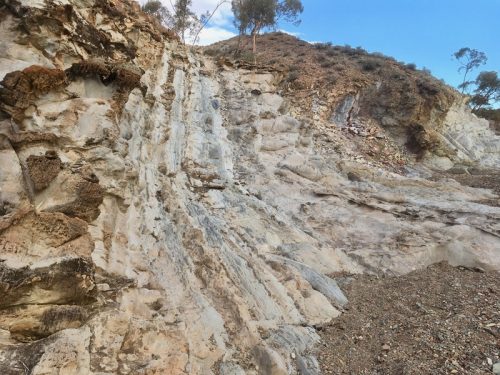
Weathered sandstone:
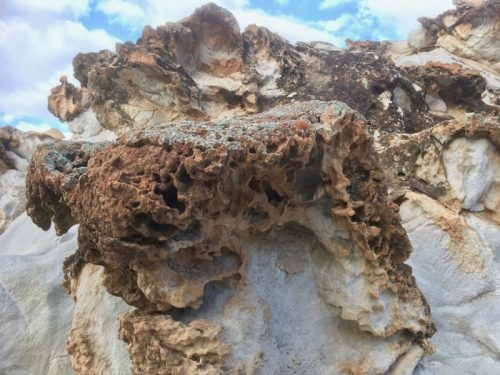
Continue reading “Glacial geological formation: sedimentary deposits”

Bunyeroo Formation meets Wonoka Formation

This gully parallel to Glass Gorge Rd near Blinman delineates two chapters of sedimentary deposition in the formation of the Flinders Ranges – the Bunyeroo Formation purple shale (right), and white-weathering calcareous Wonoka Formation (left).

An amazing overview of the formation of the Flinders Ranges can be found in our feature essay, Legacy of Time, by the Royal Geographical Society of South Australia.

Barite sand nodules

Example of barite sand nodules in a Rawnsley Quartzite boulder formed in shallow water below the surface of the sand, with quartz grains cemented by barium sulphate later replaced by fine grained quartz to form lumps.

Bonney Sandstone Formation

The Bonney Sandstone Formation is the result of deposition of iron-stained sand, silt and mica, eroded from older igneous rocks to the west and transported by rivers into a large delta. This formation has a distinctive reddish colour, and is often seen alongside the harder weathering prominent peaks of Rawnsley Quartzite which was formed from white sands, 600 million years ago. See the essay Legacy of Time by The Royal Geographical Society of South Australia for the riveting story of the formation of the Flinders Ranges.

Wonoka Formation Stromatolites

Stromatolites are fossilised biochemical accretionary structures created by Cyanobacteria (‘blue-green algae’) colonies which form microbial mats and laminated mounds in shallow saline waters.  These specimens of early life were trapped and preserved in the limey mud of the Wonoka Formation laid down in the marine trough of the Adelaide Geosyncline 570-580 million years ago.

Stromatolites in Bunyeroo Creek, Ikara-Flinders Ranges National Park
Continue reading “Wonoka Formation Stromatolites”

Geological Field Excursion Guides to Arkaroola

Arkaroola Education and Research Foundation with the Geological Survey of South Australia have published an excellent series of Geological Field Excursion Guides. Volume 1 is a self-guided driving tour from Arkaroola Village to Paralana Hot Springs, and Volume 2 is from Arkaroola Village to Sillers Lookout. The guides contain localised geological maps, satellite images and site photographs, with clear instructions on how to find specific formations en route. The accompanying geological notes are highly informative and a wonderful way to discover the stunning geological diversity of Arkaroola.

Hardcopies may be available for purchase in the Arkaroola Village shop or for viewing at the Leigh Creek Library on your way to Arkaroola.

It’s advisable to download a free PDF copy of the Geological Field Excursion Guides in advance. These have been provided by SARIG.

Continue reading “Geological Field Excursion Guides to Arkaroola”