
A view of the Copley Quartzite formation that contains Aroona Dam, and in the distance the Brachina siltstone formation of the Bayley Range.

A view of the Copley Quartzite formation that contains Aroona Dam, and in the distance the Brachina siltstone formation of the Bayley Range.
The distinctive peaks of Arkaroola as seen from the north of the Gammon Ranges.

North of the quartzite pound are precambrian formations of shale and limestone of the Tapley Hill and Amberoona formations.


Groundwater coming up through rock layers as springs are essential to life in the Flinders Ranges.


Dramatic Mamma clouds forming over Lyndhurst Ochre Pit.

This xenoclast has been plucked from ancient basement rock at a great depth, beneath the shales and sandstones of the Flinders Ranges. Such clasts were carried up very slowly by a column of hot fluid rock salt (a bit like lava) in an intrusion-like structure known as a ‘diapir’. The salt column of the Blinman Diapir is kilometers in diameter and at least a kilometre to its base. Its shape and its emplacement mechanism have much in common with a lava lamp.
This outcrop can be seen on the roadside of Glass Gorge, 200m past the grid heading west from Blinman.


The Nuccaleena Formation is a narrow pink dolomite layer that is frequently found in outcrops across the Flinders Ranges, and is described as being a good ‘geological marker horizon’.
This Nuccaleena Formation outcrop, just 5m wide, is seen in Parachilna Gorge, between the Brachina Formation siltstones and the older calcereous Elatina and Trezona Formations.
Read more about the formation of the Flinders Ranges in The Legacy of Time.
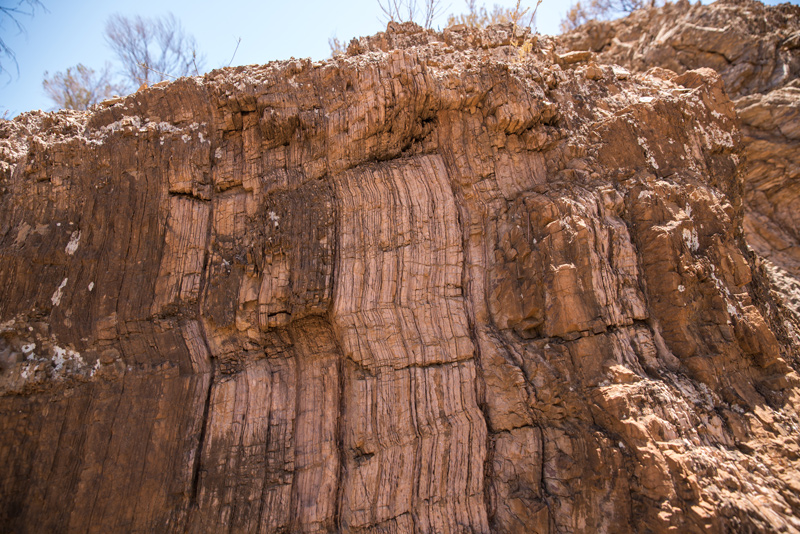
At 10.2 kilometres in from the turnoff from the Outback Hwy into Parachilna Gorge, the geological boundary between Precambrian period and Cambrian period sediments can be sighted.


Outcropped Silcrete and Sand Calcite are a recurring combination, as seen here in Copley and along the Strzelecki Track.

Unusual goethite formations found in the Leigh Creek area.
