
Mt Neill Granite is exposed in a rocky creek near Paralana Hot Springs. The red feldspars of this 1580 million year old formation present in a variety of forms.


Mt Neill Granite is exposed in a rocky creek near Paralana Hot Springs. The red feldspars of this 1580 million year old formation present in a variety of forms.
This lightweight Kaolinitic Granite at NE Arkaroola is an alteration of Mt Neil Granite. Hydrothermal fluids have destroyed the micas and replaced the feldspars of the original granite (1580 million years old) with Kaolinite.

For more information on how to locate this site, see Geological Field Excursion Guides.
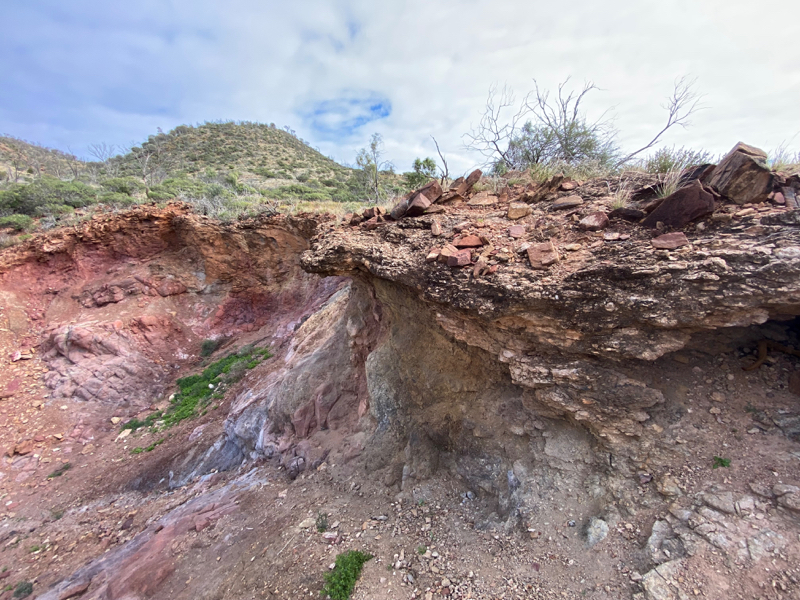
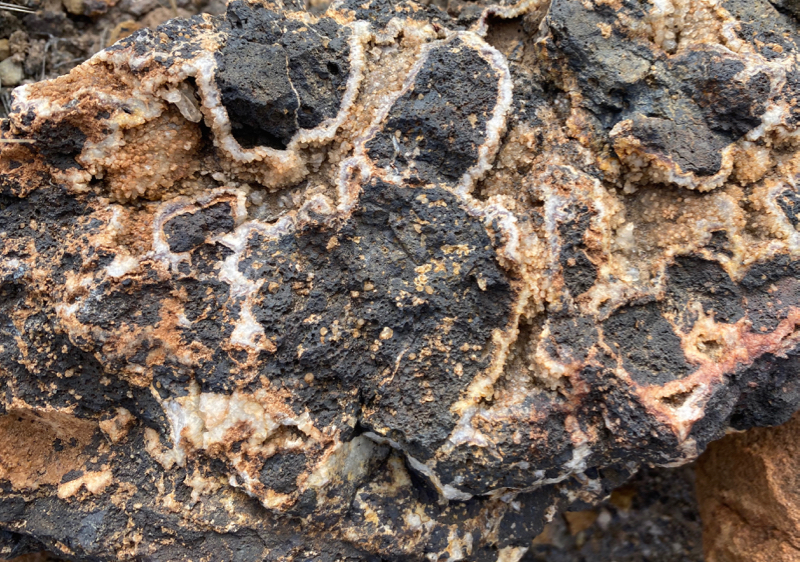
The Wooltana Volcanics formation (830 million years ago) is visible on exiting Claude Pass on the Paralana Road at Arkaroola.
For more information on how to locate this site, see Geological Field Excursion Guides.
Ripple marks, mud cracks and rain drop imprints indicate a shallow aquatic environment when the sediments of the Wortupa Quartzite formation were deposited around 790 million years ago.


For more information on how to locate this site, see Geological Field Excursion Guides.
The Acraman Story is a fascinating interactive presentation outlining the discovery of the Acraman ejecta layer by geologist Dr Victor Gostin and his colleagues.
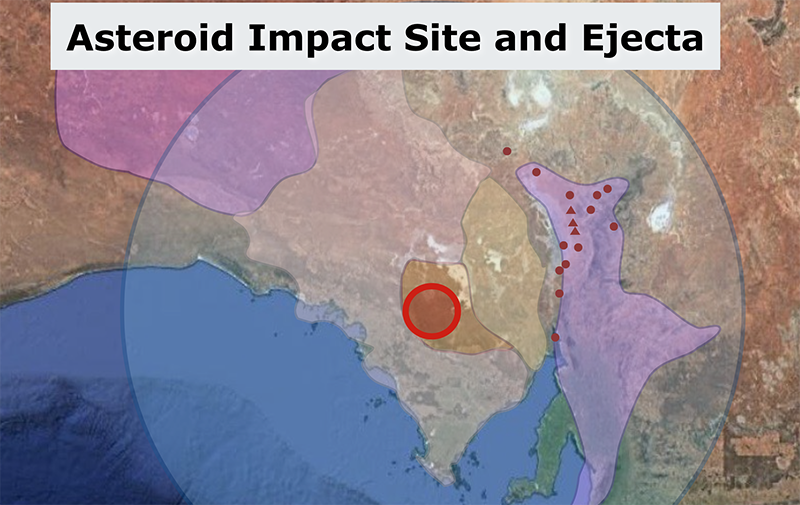
The Acraman layer is a narrow pebbly deposit of volcanic material set within the purple siltstone of the Flinders Ranges Bunyeroo Formation. While the oldest rocks of the Flinders Ranges were 900my, the Acraman samples were dated at 1600my. Early speculation pointed toward a volcanic bomb coming from the near west but this and other suggestions of deposition by glacial rafting, cliff debris or river movement were not viable.
After years of investigation, attention turned to the possibility of asteroid impact. A large asteroid impact scar (30-90km diameter) was found in the 1600my granite rich Gawler Ranges to the west of the Flinders Ranges – a perfect date match for the Acraman volcanic deposit.
The team pieced together an amazing story. The 4.8km wide Acraman asteroid hit the Gawler Ranges at around 22km per second around 680my, the age of the Bunyeroo silts. The asteroid itself was vaporised on impact and the impact into the ancient volcanic terrain displaced granitic rock (ejecta) layer which landed as far as the Flinders Ranges to the east.
Enter the The Acraman Story interactive.
Mighty upright cross-bedded quartzite lining Frome Creek, northern Flinders Ranges.


The Merinjina Tillite was formed by glacier transportation of silts, sands, rocks and boulders which came to settle on the sea floor as the glacier melted, 643 -750 million years ago.
For more information on how to locate this site, see Geological Field Excursion Guides.

Volcanics are not a common sight in the Flinders Ranges but an example of Wooltana Volcanics is visible on the Paralana Hot Springs Road at Arkaroola. The role of volcanic activity in the formation of the Flinders Ranges is outlined in the essay Legacy of Time by the Royal Geographical Society of South Australia.
For more information on how to locate this site, see Geological Field Excursion Guides.


Limestones and Dolomites of the Balcanoona formation were fractured by fault activity and infilled with silica rich waters, cementing into this silicified breccia on the Paralana Hot Springs road.
For more information on how to locate this site, see Geological Field Excursion Guides.

The stunning Ochre Wall on the road to Paralana Hot Springs is the comprised of weathered laminated silts and shales of the Angepena Formation.

For more information on how to locate this site, see Geological Field Excursion Guides.