
Example of barite sand nodules in a Rawnsley Quartzite boulder formed in shallow water below the surface of the sand, with quartz grains cemented by barium sulphate later replaced by fine grained quartz to form lumps.


Example of barite sand nodules in a Rawnsley Quartzite boulder formed in shallow water below the surface of the sand, with quartz grains cemented by barium sulphate later replaced by fine grained quartz to form lumps.
The Bonney Sandstone Formation is the result of deposition of iron-stained sand, silt and mica, eroded from older igneous rocks to the west and transported by rivers into a large delta. This formation has a distinctive reddish colour, and is often seen alongside the harder weathering prominent peaks of Rawnsley Quartzite which was formed from white sands, 600 million years ago. See the essay Legacy of Time by The Royal Geographical Society of South Australia for the riveting story of the formation of the Flinders Ranges.


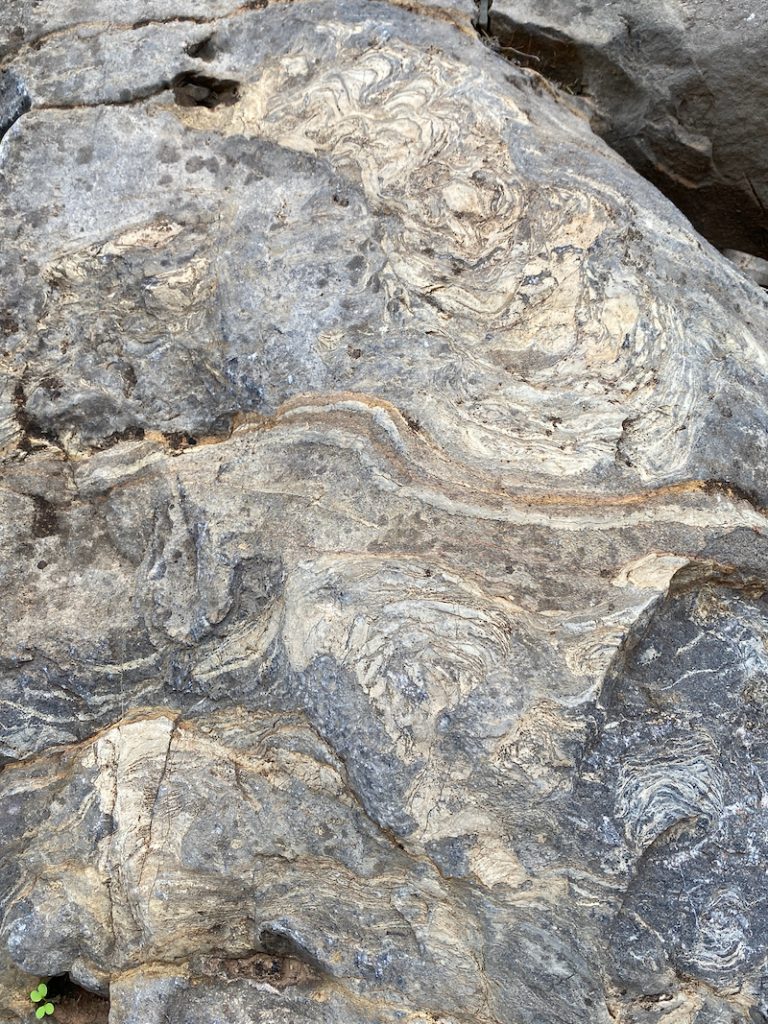
Stromatolites are fossilised biochemical accretionary structures created by Cyanobacteria (‘blue-green algae’) colonies which form microbial mats and laminated mounds in shallow saline waters. These specimens of early life were trapped and preserved in the limey mud of the Wonoka Formation laid down in the marine trough of the Adelaide Geosyncline 570-580 million years ago.
This outcrop of nodular limestone can be seen 4km into Bunyeroo Creek from the road. Part of the Wilkawillina Limestone Formation (dating 530 million years ago), the origins of this lumpy limestone remain a mystery.


Spiny leaves of young and well-watered Hakea ednieana, also known as Corktree, in Brachina Gorge.


Quite a lot of this ropy scat has been seen in the Ikara-Flinders Ranges National park. Many specimens appeared to consist mostly of fur, so it presumably the scat of a carnivore such as a fox or a quoll. If you can identify it, let us know!


Putrefaction of a frog’s body, suspended on an algal mat in a shallow spring.

Long-jawed Orbweaver (likely a species of Tetragnatha) on lavender. Body length 18mm.
