Casuarinapauper is also known as Black Oak, Scrub Sheoak, Bulloak, Belah, and Alku. Casuarinas belong to an ancient family of plants with foliage consisting of segmented waxy photosynthetic branchlets commonly referred to as needles. Tiny leaves form a crown, or teeth-like ring, at the branchlet joints. New growth was observed in mid-summer at Ikara-Wilpena Pound.
Arkaroola Education and Research Foundation with the Geological Survey of South Australia have published an excellent series of Geological Field Excursion Guides. Volume 1 is a self-guided driving tour from Arkaroola Village to Paralana Hot Springs, and Volume 2 is from Arkaroola Village to Sillers Lookout. The guides contain localised geological maps, satellite images and site photographs, with clear instructions on how to find specific formations en route. The accompanying geological notes are highly informative and a wonderful way to discover the stunning geological diversity of Arkaroola.
Australian Geology Travel Maps by Trilobite Solutions is a simple and effective mobile app that operates offline. In addition to terrain and satellite maps, it offers a selection of interactive maps of Australia and NZ for a flat rate of $11.99 per year. These include detailed and simple geological maps by state. This is a wonderful way to locate your position on the geological map and to instantly display geological information about your immediate location. The app also has a voice function that informs you about the geology whenever there is a change, which is great for road trips.
Mineral, exploration and mining data layers can also be downloaded, and various layers can be overlaid. Locations and trails can be recorded and exported in various GPS formats.
As the internet in the Flinders can be patchy and weak, it is advised that all maps and layers be downloaded in advance. The simple geological map for SA was around 1gb and the detailed geological map for SA was around 1.4gb.
This app could very well be an improvement on using a magnifying glass to read a geological map flapping in the wind on a hot car bonnet.
The Brown Songlark (Cincoramphus crularis) is a nomadic species, appearing in the treeless green plains between Copley and Lyndhurst after wet spring. Breeding season is between September and February, when females build nests in a ground hollow or clump of groundcover or grass, while the males undertake song flights with loud, bright trill songs.
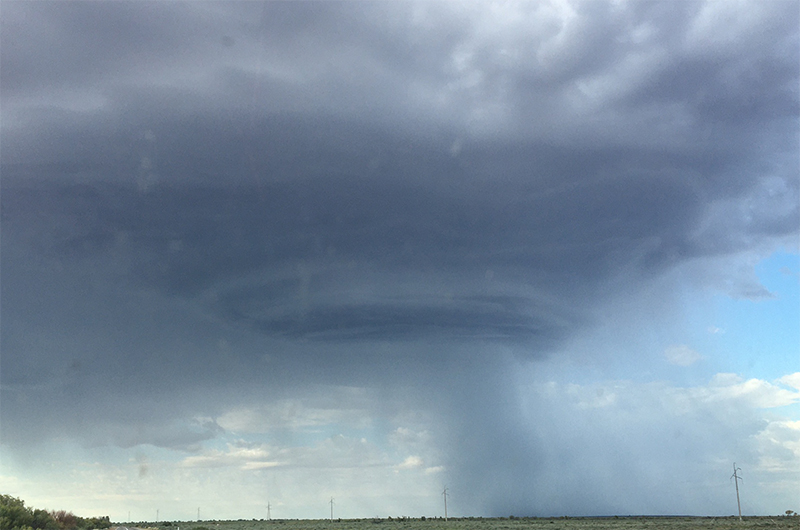
On a wild stormy day for South Australia, with 423,000 lightning strikes hitting the state, this supercell rotating updraft thunderstorm formation was seen over Nilpena Station.