
Lunar eclipse captured with 400mm telephoto lens on a tripod.


Lunar eclipse captured with 400mm telephoto lens on a tripod.
Jupiter’s moons Io, Callisto, Ganymede and Europa, captured with 400mm telephoto lens on a tripod.

Ripple rock formations can be seen throughout the Flinders Ranges. This sandstone deposit near Melrose was formed by wave action in the waters of the Adelaide Geosyncline 650 million years ago.

The ripple sandstone layer was preserved under a subsequent layer of finer sediments deposited in calmer waters, suggesting a rise in sea level, resulting in the siltstone layers (to the left of the image below). This formation was upended 500 million years ago when the Adelaide Geosyncline folded into a mountain chain. Continue reading “Ripple rocks”
Winter morning mists in the Flinders Ranges.

Also known as a sun dog, this parhelion is a halo phenomenon resulting from refracted sunlight by ice crystals of high clouds when the sun is low on the horizon.
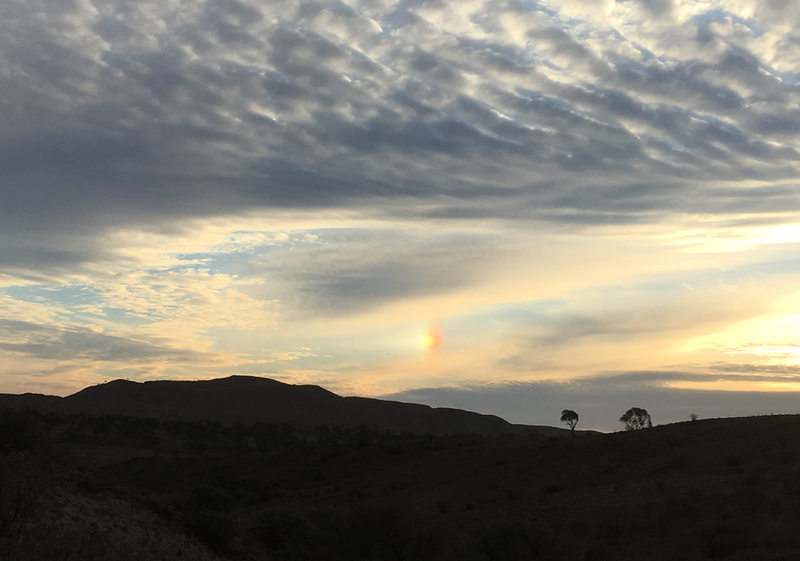
Altocumulus stratiformis clouds forming parallel bands.

Female Raspy Cricket with ovipositor projecting from abdomen.


Tobacco Bush Creek flows across the Outback Hwy north of Copley. This groundwater provides a vital flowing waterway for many species including fish, reptiles, invertebrates and birds. Birds SA reported 13 species of birds in the creek during a brief 6 hour survey in April 2018, finding the following:
Well worn tracks of native animals cover the banks of the watercourse.
Malachite pseudomorph after azurite crystals.


