
The endangered, highly localised and somewhat ethereal Balcanoona Wattle (Acacia araneosa) is not easy to spot in the bush but fortunately can be viewed in a garden plantation at Arkaroola Village.

The endangered, highly localised and somewhat ethereal Balcanoona Wattle (Acacia araneosa) is not easy to spot in the bush but fortunately can be viewed in a garden plantation at Arkaroola Village.
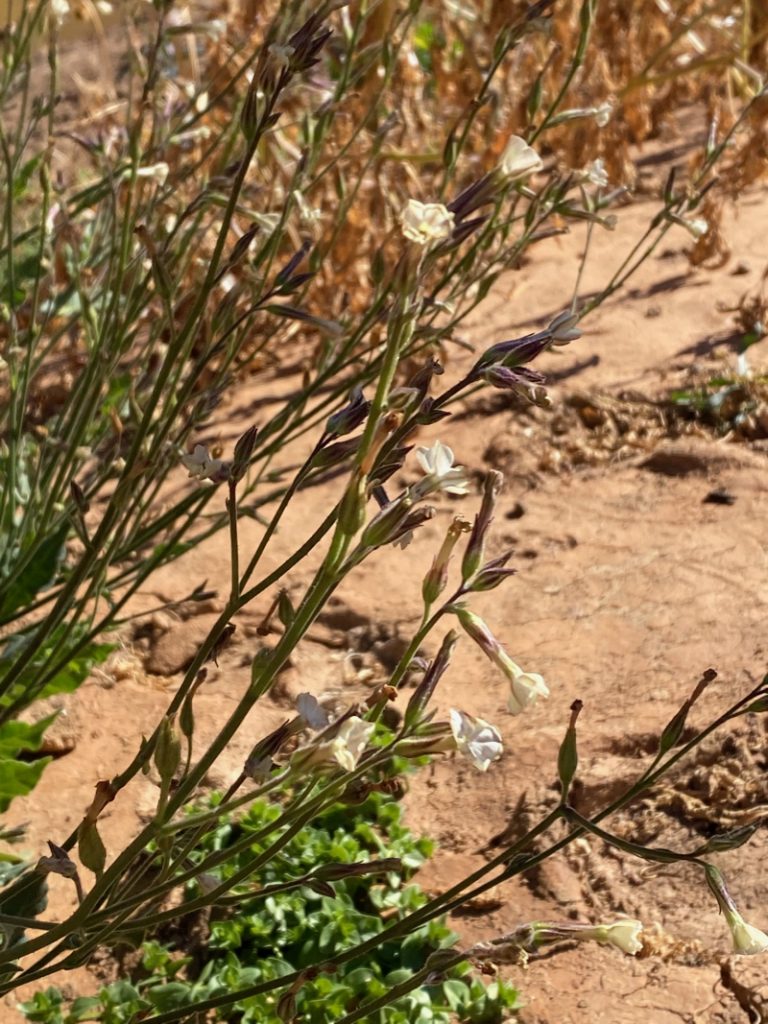
Velvet Tobacco, Nicotiana velutina, is a relative of Pituri flowering during mid winter at Stubbs Waterhole, Arkaroola.


The Merinjina Tillite was formed by glacier transportation of silts, sands, rocks and boulders which came to settle on the sea floor as the glacier melted, 643 -750 million years ago.
For more information on how to locate this site, see Geological Field Excursion Guides.

Volcanics are not a common sight in the Flinders Ranges but an example of Wooltana Volcanics is visible on the Paralana Hot Springs Road at Arkaroola. The role of volcanic activity in the formation of the Flinders Ranges is outlined in the essay Legacy of Time by the Royal Geographical Society of South Australia.
For more information on how to locate this site, see Geological Field Excursion Guides.


Limestones and Dolomites of the Balcanoona formation were fractured by fault activity and infilled with silica rich waters, cementing into this silicified breccia on the Paralana Hot Springs road.
For more information on how to locate this site, see Geological Field Excursion Guides.

The stunning Ochre Wall on the road to Paralana Hot Springs is the comprised of weathered laminated silts and shales of the Angepena Formation.

For more information on how to locate this site, see Geological Field Excursion Guides.

Ripple rocks seen throughout the Flinders Ranges are likely to have been formed in sandy shallow waters, rapidly covered in kilometres of sediments which resulted in rock formation through processes of heat and pressure. This example is part of the Blue Mine Conglomerate Formation, around 800 million years old.
For more information on how to locate this site, see Geological Field Excursion Guides.
An outcrop of Blue Mine Conglomerate Formation can be seen at Kingsmill Creek near the Arkaroola Homestead. This conglomerate was formed around 800 million years ago and contains fragments of blue quartz from the 1.59 billion year old Mount Neil Granite Formation seen closer to Paralana Hot Springs. The Blue Mine Conglomerate was likely formed from shoreline or fluvial deposition and is seen at this site as a weathered pavement surrounding a waterhole.


For more information on how to locate this site, see Geological Field Excursion Guides.


This Opaminda Formation near the Arkaroola Village was deposited in shallow waters around 800 million years ago. This lightly metamorphosed outcrop exposes ripple marked sandstone, laminated and a green talcose siltstone (pictured).
For more information on how to locate this site, see Geological Field Excursion Guides.
Discover the Flinders Ranges is a free app designed by Friends of Ikara-Flinders Ranges National Park. The app contains tours and around 500 photos of places of interest, as well as some plants and birds.

While the ‘Flora of the Central Flinders Ranges’ tour is not comprehensive, it is novel in that it is arranged by colour of flower. A handy little offline app to have in the field.