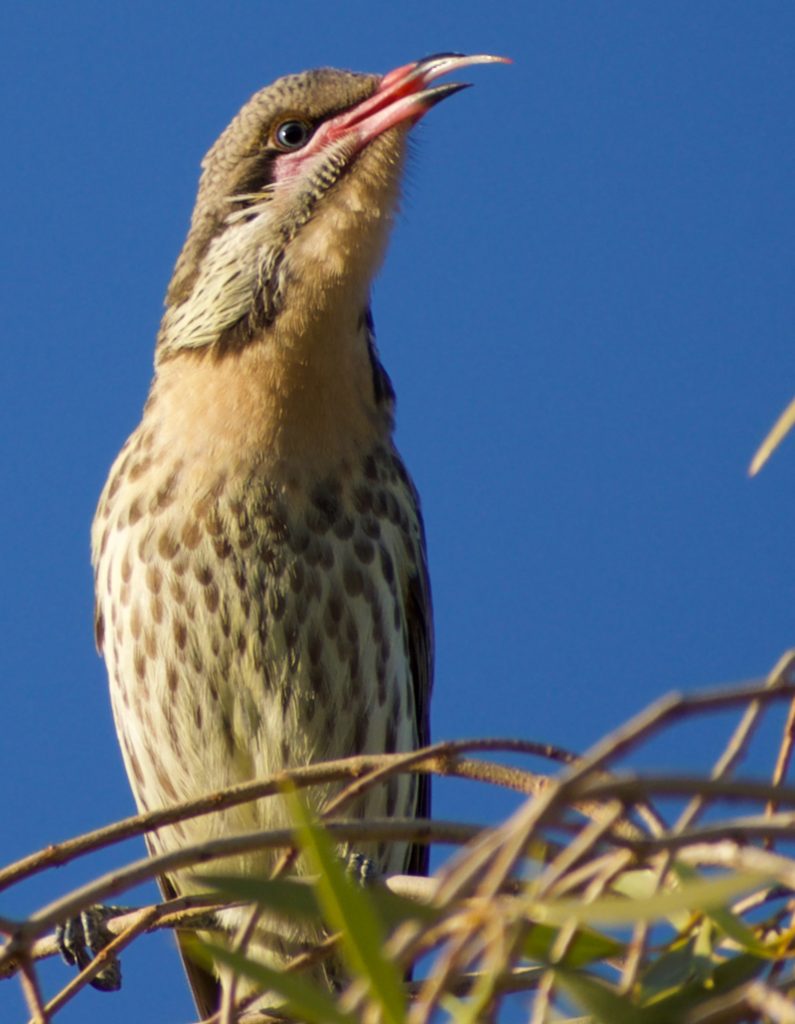
Aroona Sanctuary in the Northern Flinders Ranges not only hosts the Aroona Dam but also overflow and spring waters which provide fertile habitat for a wide variety of birds and other wildlife.

Aroona Sanctuary in the Northern Flinders Ranges not only hosts the Aroona Dam but also overflow and spring waters which provide fertile habitat for a wide variety of birds and other wildlife.
These Australian Ringnecks (Barnardius zonarius) seen at Aroona Sanctuary are a hybrid of the Port Lincoln Parrot and Mallee Ringneck. Male displays include wagging and fanning of the tail and drooping of the wings to display vivid blue feathers.


Psyllids are sap sucking insects which excrete a sugary starch to form lerps – white shelter casings. Lerps are a sweet bush food that can be occasionally found around Eucalypts in the Flinders Ranges.
Continue reading “Lerps on Eucalyptus”
The Little Grassbird (Megalurus gramineus) is seen in the Flinders Ranges foraging on the rocky clay plains.
Continue reading “Little Grassbird”
Trichodesma zeylanicum, commonly known as Cattlebush, Water Bush, Camel Bush, Rough Bluebell Browntop, is commonly seen in sandy plains of outback SA, seen here in a rocky gully in the Flinders Ranges. Pollinated by the Australian Lesser Wanderer Butterfly among others.


Notched Twin-leaf (Zygophyllum emarginatum) is a succulent annual seen in the Flinders Ranges after rains in the cooler months.
Continue reading “Notched Twin Leaf”The White-winged Fairy-wren (Malurus leucopterus) breeding male is cobalt blue with bright white wings. The call is a distinct circling trill which is the best indication of where these discrete birds may be sighted.


Juveniles and females are pale brown, light breasted, tails with a tint of blue. They do not have the distinctive eye markings of the Variegated Fairy-wrens with whom they share shrubby habitat on the Copley commons.