
Also known as the Clustered Sea-heath or Bristly Sea-heath, Frankenia serpyllifolia flowering in the sandy clays near Lyndhurst.

Also known as the Clustered Sea-heath or Bristly Sea-heath, Frankenia serpyllifolia flowering in the sandy clays near Lyndhurst.

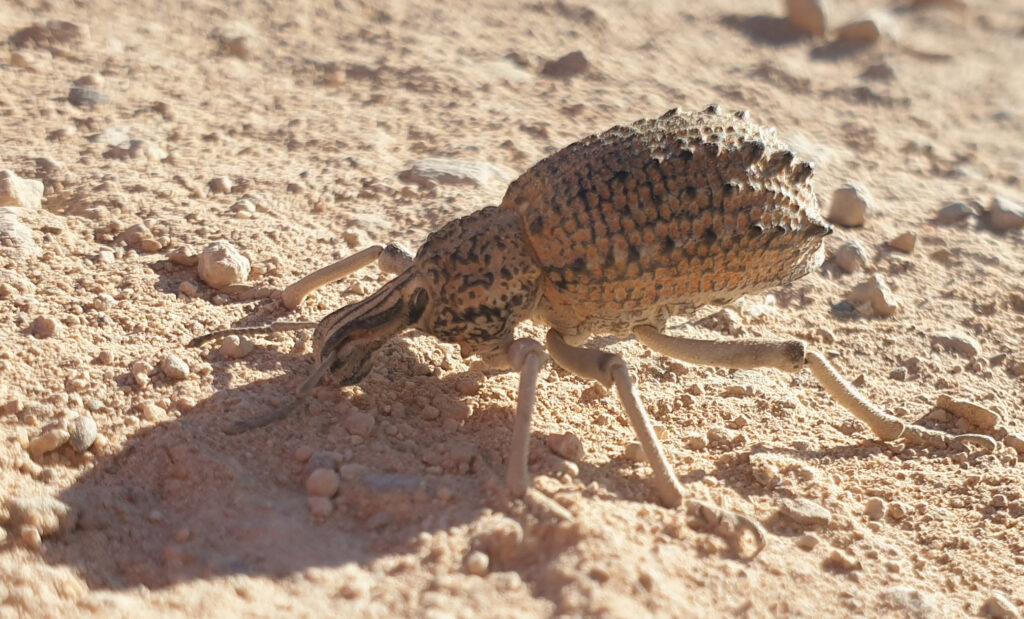
5cm weevil (Leptopius gravis), also known as a Wattle Pig or Elephant Weevil, Beltana.
The Golden Orb-weaving Spider (Nephila edulis) produces a high tensile, highly elastic golden silk strong enough to ensnare small bats and birds. Not only is the silk being used traditionally as fishing line in New Guinea and Vanuatu, Australian Geographic tells us that “there are high hopes for bulletproof vests, as well as violin strings, tennis rackets, nets, textiles and surgical products”.

The desert river systems of the Channel Country are filling Lake Eyre from the north. As floodwaters flow toward the inland Great Artesian Basin, the arid land is transforming into an unusually green vista that can be viewed from the air. Flights over Lake Eyre and the Channel Country are available from William Creek.


The isopods (Phreatomerus latipes) living in the trickling overflow of the unique and beautiful Mound Springs north of the Flinders Ranges may look like garden slaters but are in fact a rare and ancient species of crustacean endemic to the ecological niche of the desert springs. Learn more about these evolutionary time capsules of the desert on the Friends of Mound Springs website.


Spider-hunting Scorpion found in Australia’s arid inland, hunting Trapdoor Spiders by night and taking refuge in the burrows of their prey by day. 3-5cm.

Male red kangaroos sparring at night, caught by the wildlife camera at Beltana’s town well.

Professor Alan Collins from the University of Adelaide’s Earth Sciences Department in School of Physical Sciences is part of an international team who have reconstructed a one billion year history of the Earth’s tectonic plates.
Find out more about this amazing project in Cosmos Magazine’s article Tectonic Timelapse.