The Flinders Ranges has been tentatively listed by UNESCO for World Heritage. This video by the SA Department of Environment and Water outlines the evolution of life on Earth discovered in fossils and geology of the Flinders Ranges and its international significance.
Vapour trails, or contrails, are high altitude linear clouds generated by engine exhaust or changes in air pressure from aircraft flight paths, composed primarily of ice crystals. Seen here crossing the path of a waning crescent moon during a colourful Flinders Ranges dawn in autumn.
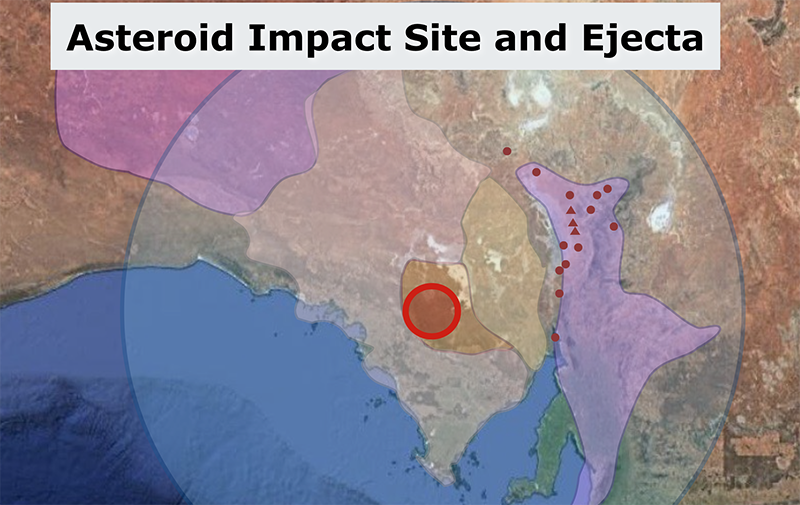
The Acraman Story is a fascinating interactive presentation outlining the discovery of the Acraman ejecta layer by geologist Dr Victor Gostin and his colleagues.
The Acraman layer is a narrow pebbly deposit of volcanic material set within the purple siltstone of the Flinders Ranges Bunyeroo Formation. While the oldest rocks of the Flinders Ranges were 900my, the Acraman samples were dated at 1600my. Early speculation pointed toward a volcanic bomb coming from the near west but this and other suggestions of deposition by glacial rafting, cliff debris or river movement were not viable.
After years of investigation, attention turned to the possibility of asteroid impact. A large asteroid impact scar (30-90km diameter) was found in the 1600my granite rich Gawler Ranges to the west of the Flinders Ranges – a perfect date match for the Acraman volcanic deposit.
The team pieced together an amazing story. The 4.8km wide Acraman asteroid hit the Gawler Ranges at around 22km per second around 680my, the age of the Bunyeroo silts. The asteroid itself was vaporised on impact and the impact into the ancient volcanic terrain displaced granitic rock (ejecta) layer which landed as far as the Flinders Ranges to the east.
Castor oil plant (Ricinus communis) is an introduced species historically cultivated for its oil which is used in food, medicine, industry and, some would argue, as a way of torturing children. Escaping from gardens, it can be seen in some waterways in the Flinders Ranges. Following floods, this stand south of Parachilna is growing up to 4 metres tall.
While flowers lack petals, female flowers have showy red stigmas and male flowers have numerous creamy yellow stamens. Flowering here in March.
Praying Mantis nymphs under observation by junior field naturalists at Mt Lyndhurst. These day old nymphs look like adult mantids but have no wings or reproductive organs. The egg sac, or ootheca, is 3cm long and the nymphs are approximately 1cm. If the nymphs are not separated soon, they may start cannibalising each other in their second instar.