
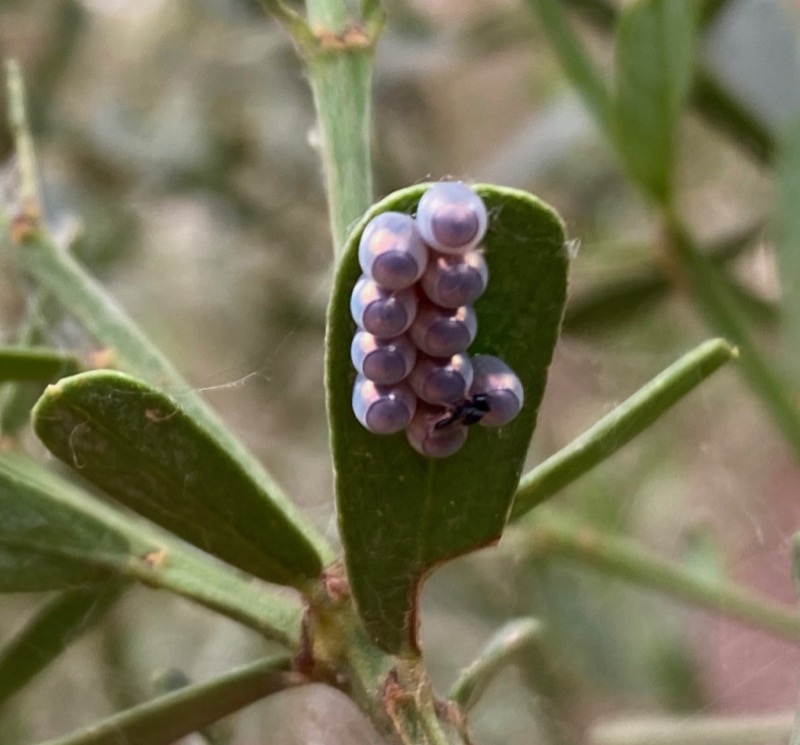
Insect Eggs
Santalum lanceolatum is known variously as Native Plum, Bush Plum, Plumbush. As with the related Quandong, it is semi-parasitic in that it will connect its roots to other trees. Seen commonly in the Flinders Ranges in clay and sandy plains and watercourses.
The dark fruit is a bland but palatable bush food, similar looking to the inedible fruit of Eremophila longifolia. Species feeding on the berries include the Singing Honeyeater.

Tribulus eichlerianus, also known a Bull-head or Caltrop is a prostrate herb flourishing in the Flinders Ranges after substantial rain. The woody fruit is distinguished by bulbous segments and sharp spines.

Nitraria billardierei, commonly known as Nitrebush, is a spreading perennial seen here in the saline clays around Copley. The sour, salty fruit is a bush food, eaten raw or made into jams and sauces.


Wahlenbergia communis, the Tufted Bluebell is seen here in a clay creek bank at Yankaninna.

Also known as Corkbark and Corktree, the Hakea ednieana grows on rugged shale slopes and gullies. Seen here on a rise in Glass Gorge in the Northern Flinders Ranges.


This cluster of communal foliage spider nests can be seen in a Jointed Cherry (Exocarpos aphyllus) located at the car park at Aroona Dam in the Northern Flinders Ranges.


Farina is located between Lyndhurst and Marree in the Great Artesian Basin. Thanks to Farina Station for providing this extensive list of sighted birds. The beautiful campground at Farina Station is the perfect base for bird watching and at certain times of the year you can even get a feed from the historic underground woodfired bakery while you are there.
Emu, bustard, brolga, wedge-tailed eagle, little eagle, black-breasted kite, whistling kite, black kite, black-shouldered kite, letter wing kite, brown falcon, Nankeen kestrel, brown goshawk, Australian raven, little crow, boobook owl, tawny frogmouth, owlet nightjar, Australian magpie, magpie lark, galah, little corella, budgerigar, cockatiel, red-rumped parrot, Australian ringneck, mulga parrot, scarlet-breasted parrot, blue bonnet, crested pigeon, diamond dove, feral pigeon, peaceful dove, masked plover, Richard’s pipit, Australian pratincole, Australian dotterel, black fronted dotterel, cinnamon quailthrush, welcome swallow, white backed swallow, tree martin, fairy martin, black faced woodswallow, masked woodswallow, dusky woodswallow, white-breasted woodswallow, house sparrow, willie wagtail, variegated fairy-wren, white-winged fairy-wren, splendid fairy-wren, fieldwren, red-capped robin, hooded robin, rufous whistler, white winged triller, grey fantail, chirruping wedgebill, white browed babbler, restless flycatcher, satin flycatcher, brown songlark, rufous songlark, yellow rumped thornbill, southern whiteface, chestnut breasted whiteface, crimson chat, orange chat, red browed pardalote, striated pardalote, zebra finch, mistletoe bird, white-plumed honeyeater, singing honeyeater, spiny-cheeked honeyeater, black honeyeater, pied honeyeater, yellow throated miner, pallid cuckoo, rufous-tailed bronze cuckoo, black-faced cuckoo-shrike, rainbow bee-eater, red-backed kingfisher, black-tailed native hen, Nankeen night heron, white-faced heron, Pacific (white-necked) heron, large egret, white ibis, silver gull, gull-billed tern, red-necked avocet, Australian pelican, black swan, great black cormorant, little black cormorant, hoary headed grebe, Australasian little grebe, grey teal, Pacific black duck, pink-eared duck, white-eared duck, wood duck.
