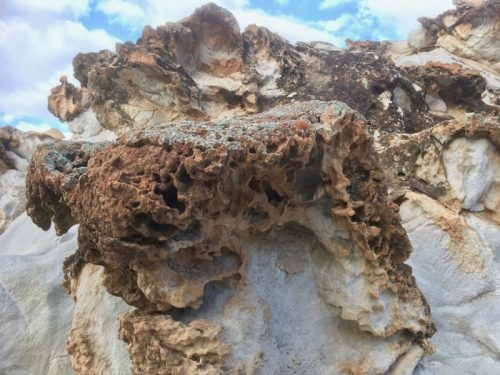
Moro Gorge is a cascading series of spring-fed waterholes located in the Nantawarrina Indigenous Protected Area in the northern Flinders Ranges. The surrounding limestone walls appear to have precipitated from mineral-rich spring water, forming tufa columns and flowstone. Calcrete is also present in the area—a type of limestone conglomerate consisting of pebbles bound within a calcium carbonate matrix.
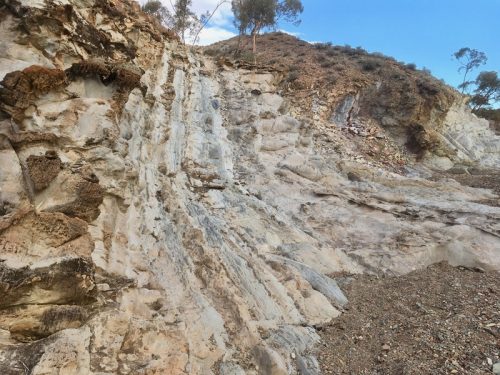
Muddy limestone turbidite, formed from sediment deposits in offshore silty waters during the Cambrian period (around 550 million years ago). The dramatic localised buckling seen here may have occurred in situ during a turbulent underwater event. This rock is part of the Mernmerna Formation in the northern Flinders Ranges.
Laminar manganese-rich limestone of the Nepabunna Formation, formed during the Cambrian period, is now exposed and weathering on the plains north of the Flinders Ranges.
This striking outcrop near Copley exhibits a range of sedimentary deposits. From the north to south, green shale and blocky siltstone meets weathered sandstone. This is followed by a distinct tillite layer between two dolomite layers, and a thin layer of quartzite. Further along, siltstone layers coloured by iron oxide, and more weathered sandstone.
Recent studies in the area suggest that the northern Flinders Ranges area was a shallow marine or lagoonal setting prior to the climate changing into one of the earth’s most severe glaciations ever recorded (the global Sturtian Glaciation), 720 million years ago . Over these older rocks, we find layers of pebbly, mixed rocks (called diamictites) that were likely deposited by a glacier at its edge, along with some sand layers (Bolla Bollana Tillite). These rock layers are thought to show the movement of the glacier as it advanced and retreated along the coastline. These layers then change into sandstones and mudstones with large rocks (called dropstones), which probably formed when the ice started to melt, in an area just in front of the retreating glacier (Wilyerpa Formation). After the glacier melted, the layers of rock that formed (Tapley Hill Formation) include thin, layered shales and carbonates that were deposited underwater.
This albino kangaroo was sighted south of Hawker in May, 2018. In April, 2025 another sighting of an albino kangaroo was made on the road between Blinman and Parachilna. Anecdotal evidence suggests that there may be several in the central Flinders Ranges. Kangaroo hunters over the years have avoided shooting white kangaroos and report several variations in eye and fur colouration.
An albino bird has been sighted once over summer at a backyard birdbath in Copley. The shape and size of the bird suggested a Yellow-throated Miner, or perhaps a Spiny-cheeked Honeyeater. Plumage was entirely white, with yellow legs and yellow beak. Let us know if you spot it and please send us a photo!
The recent earthquake activity around Hawker in the Flinders Ranges can be monitored at Geoscience Australia. If you feel an earthquake, you can register your data on the site.


 This albino kangaroo was sighted south of Hawker in May, 2018. In April, 2025 another sighting of an albino kangaroo was made on the road between Blinman and Parachilna. Anecdotal evidence suggests that there may be several in the central Flinders Ranges. Kangaroo hunters over the years have avoided shooting white kangaroos and report several variations in eye and fur colouration.


