
Waters continue to flow at Tillite Gorge, Arkaroola, in early winter after late summer floods.
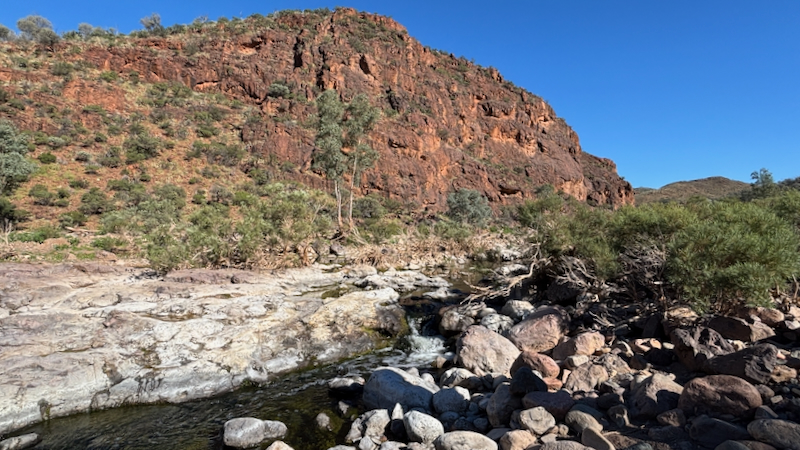
Waters continue to flow at Tillite Gorge, Arkaroola, in early winter after late summer floods.
This striking outcrop near Copley exhibits a range of sedimentary deposits. From the north to south, green shale and blocky siltstone meets weathered sandstone. This is followed by a distinct tillite layer between two dolomite layers, and a thin layer of quartzite. Further along, siltstone layers coloured by iron oxide, and more weathered sandstone.
Recent studies in the area suggest that the northern Flinders Ranges area was a shallow marine or lagoonal setting prior to the climate changing into one of the earth’s most severe glaciations ever recorded (the global Sturtian Glaciation), 720 million years ago . Over these older rocks, we find layers of pebbly, mixed rocks (called diamictites) that were likely deposited by a glacier at its edge, along with some sand layers (Bolla Bollana Tillite). These rock layers are thought to show the movement of the glacier as it advanced and retreated along the coastline. These layers then change into sandstones and mudstones with large rocks (called dropstones), which probably formed when the ice started to melt, in an area just in front of the retreating glacier (Wilyerpa Formation). After the glacier melted, the layers of rock that formed (Tapley Hill Formation) include thin, layered shales and carbonates that were deposited underwater.
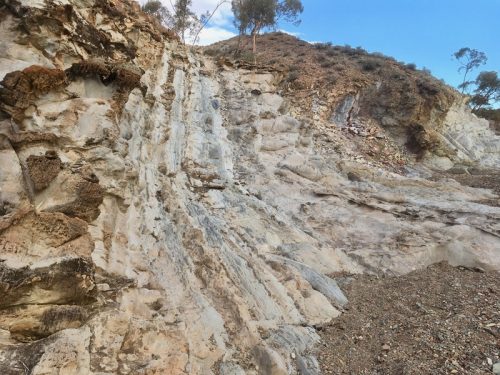
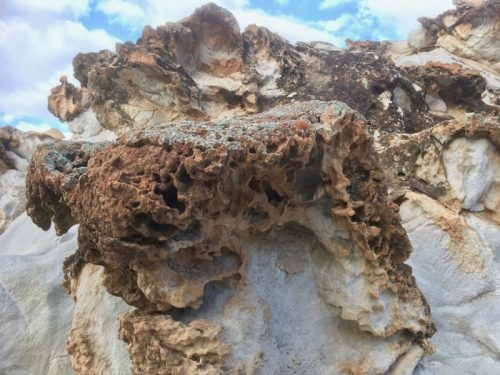
Weathered sandstone:
Willy Wagtail coming in for water at Stubbs Waterhole at Arkaroola takes a rest on the glacial rock of the Merinjina Tillite formation.


The Merinjina Tillite was formed by glacier transportation of silts, sands, rocks and boulders which came to settle on the sea floor as the glacier melted, 643 -750 million years ago.
For more information on how to locate this site, see Geological Field Excursion Guides.
Dark glacial tillite formation in Illawortina Creek along the Four Mile Track between Idninha and Arkaroola. The glacial geology of this area is outlined in The Legacy of Time: The Formation of the Flinders Ranges.


For more information on how to locate this site, see Geological Field Excursion Guides.

