About 10cm long, this is the caterpillar of an Owlet Moth (family Erebidae). It is feeding on a Broughton Willow in early March. A number of different erebid genera feed on Acacia in the Flinders Ranges, but few have been reared in order to associate the moth species involved. The white eggs on the body behind the head are the eggs of parasites.
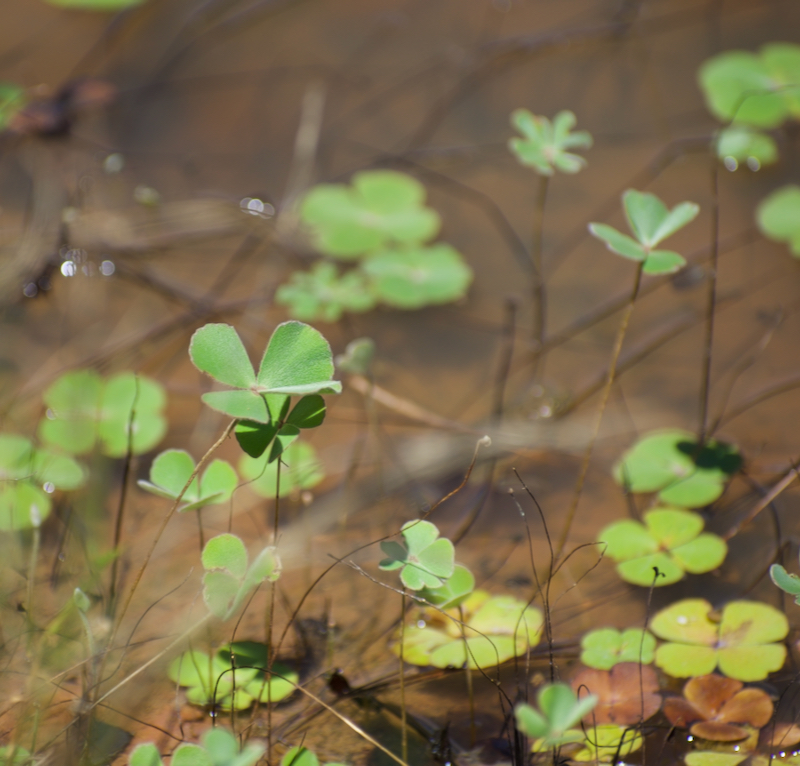
Nardoo, Marsilea drummondii, is a perennial fern with underground stems or rhizomes. It shrivels up during dry periods and withstands wet periods with leaves floating on the surface of the water. Found in floodplains and creekbeds, Nardoo is a known bush tucker. Preparation requires spore cases to be roasted, cases to be removed, with the remaining spores ground into flour.
A tiny female Crimson Chat with distinctive red uppertail coverts watches over her chicks nested in a nearby cotton bush (Maireana), in the sandy pastoral plains south of Marree.
The butterfly breeding project in the Leigh Creek School Community Library has branched into the wonderful world of Hawk-moths. These fat babies feed vigourously on local Boerhavia groundcovers and daily donations sweet potato vines, growing up to 12cm.
The installation has tied in with STEM and English studies at the school, and has already expanded into host and nectar plant cultivation in the school nursery, and an outdoor butterfly enclosure. The project has also grown to include the emergence of various Hawk-moths and other insects found in the local area.
The star of the show, however, has been the stunning Australian Lesser Wanderer Butterflies, which after pupating in surprising places around the library are emerging day by day in the Library.
Various Hawk-moths are proliferating in the Flinders Ranges after heavy rains, including the Vine Leaf Hawk-moth and this Convolvulus Hawk-moth caterpillar caught in the rather surprising act of swimming.
Convolvulus Hawk-moth caterpillar swimming on the Copley Commons
The Royal Geographic Society and Walking Trails Support Group have developed this excellent app in addition to the essential publication Explore the Flinders Ranges. The app profiles 16 iconic walks from Quorn to Arkaroola, including maps, geology notes, flora and fauna identification lists, and an accompanying geo glossary. The selected walks are marked in the landscape and are considered to be straightforward for the average walker. As always, when exploring the Flinders Ranges please observe the safety precautions outlined in the app.