The desert river systems of the Channel Country are filling Lake Eyre from the north. As floodwaters flow toward the inland Great Artesian Basin, the arid land is transforming into an unusually green vista that can be viewed from the air. Flights over Lake Eyre and the Channel Country are available from William Creek.
The isopods (Phreatomerus latipes) living in the trickling overflow of the unique and beautiful Mound Springs north of the Flinders Ranges may look like garden slaters but are in fact a rare and ancient species of crustacean endemic to the ecological niche of the desert springs. Learn more about these evolutionary time capsules of the desert on the Friends of Mound Springs website.
Spider-hunting Scorpion found in Australia’s arid inland, hunting Trapdoor Spiders by night and taking refuge in the burrows of their prey by day. 3-5cm.
Keep an eye on that orange dot for the backstory of the Flinders Ranges!
Professor Alan Collins from the University of Adelaide’s Earth Sciences Department in School of Physical Sciences is part of an international team who have reconstructed a one billion year history of the Earth’s tectonic plates.
The Flinders Ranges has been tentatively listed by UNESCO for World Heritage. This video by the SA Department of Environment and Water outlines the evolution of life on Earth discovered in fossils and geology of the Flinders Ranges and its international significance.
Vapour trails, or contrails, are high altitude linear clouds generated by engine exhaust or changes in air pressure from aircraft flight paths, composed primarily of ice crystals. Seen here crossing the path of a waning crescent moon during a colourful Flinders Ranges dawn in autumn.
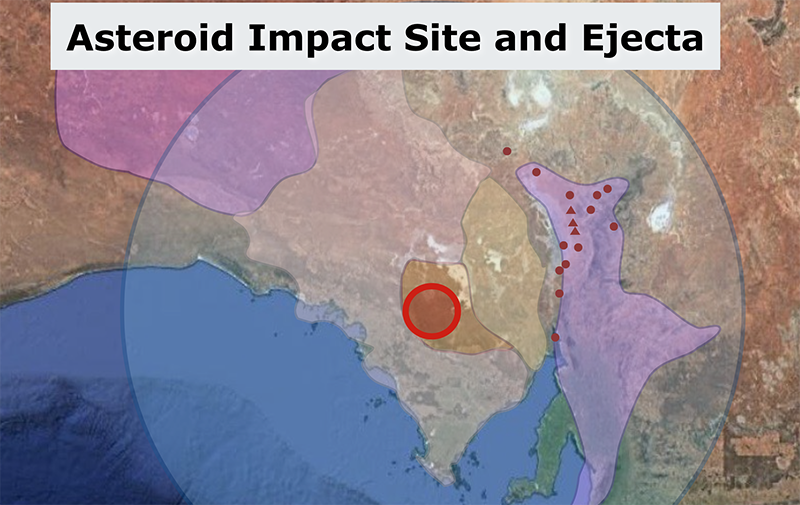
The Acraman Story is a fascinating interactive presentation outlining the discovery of the Acraman ejecta layer by geologist Dr Victor Gostin and his colleagues.
The Acraman layer is a narrow pebbly deposit of volcanic material set within the purple siltstone of the Flinders Ranges Bunyeroo Formation. While the oldest rocks of the Flinders Ranges were 900my, the Acraman samples were dated at 1600my. Early speculation pointed toward a volcanic bomb coming from the near west but this and other suggestions of deposition by glacial rafting, cliff debris or river movement were not viable.
After years of investigation, attention turned to the possibility of asteroid impact. A large asteroid impact scar (30-90km diameter) was found in the 1600my granite rich Gawler Ranges to the west of the Flinders Ranges – a perfect date match for the Acraman volcanic deposit.
The team pieced together an amazing story. The 4.8km wide Acraman asteroid hit the Gawler Ranges at around 22km per second around 680my, the age of the Bunyeroo silts. The asteroid itself was vaporised on impact and the impact into the ancient volcanic terrain displaced granitic rock (ejecta) layer which landed as far as the Flinders Ranges to the east.